Showing posts with label PC Games. Show all posts
Wednesday, September 22, 2010
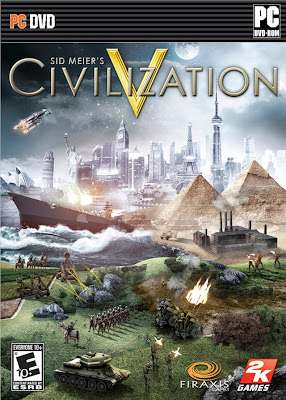
Sid Meier's Civilization V
Civilization V Review:
My Iroquois nation spreads across the world quickly, being likened to plague by my enemies. In real life this relatively small group of people was all but wiped out by the end of the 20th century, but in my game they are a force to be reckoned with -- a nation wresting control of the seas with modern navies, and taking cities by force with infantry and tanks. Manifest Destiny takes on a whole new meaning as by 2010 I've slowly but surely conquered the Americans and other European nations, subduing them to my rule or simply burning their once haughty nations to ashes.
It's a turn-based strategy game based around building up a selected society into a world power. And, yes, Civilization V can look seriously boring to the casual bystander, but for the person at the helm of the game each turn can lead to a weighty decision, giving the player a certain feeling of power that few, if any, games match.
Civilization has no campaign, instead it simply allows the players to create a world of their devising and jump right into it either by themselves or with others in multiplayer. The biggest choice a player will make is what civilization they're going to play. Each civilization is led by a great leader from history, and gets a few special benefits and units, so its' important to consider what type of victory you're out to achieve before setting your nationality. For instance the French get cultural bonuses that give them a huge bonus towards a cultural victory, while playing Germany will give players access to powerful military units like the Panzer tank that can aid in taking over the world by force. Of course you can always pick a military-focused leader and take them on a route towards a cultural victory, but this will also present a greater challenge.
Besides picking a nation, players can further customize their scenario by switching between options such as whether the world will be made of several continents or not, what era they start in (Civ moves in eras, such as Medieval, Renaissance, etc., which also influences the level of technology you have access to), and how many other civilizations they wish to compete with. It essentially makes for infinite replayability, giving players a simple tool set to craft the challenge they want in of the world over and over again.
And hell yes, this is the type of game that you want to just play over and over. Like its predecessors, Civilization V is amazingly addictive, with games commonly drawing more than five or six hours out of me in a single sitting. The reason? Because win or lose, Civilization V allows players to guide an entire society and craft their own story, taking them from the dawn of history and far into the future. I love taking the Japanese and making them into a peaceful country who wants nothing more than to make Opera houses and win over their neighbors via their culture, or take the Aztecs and fashion them into a powerful imperialistic nation that is completely fascist and obsessed with world domination. Civilization V really is what you make of it, and for me it's a good way to tell alternate stories about some of history's most interesting nations.
I say Civilization V is only "good" -- and not "great," as I would have said about Civilization IV -- at crafting stories because I feel like the game's taken away some pretty important tools for customizing your society. In Civilization IV players could force things on their country and opposing nations in the form of religions and government. In Civilization V, though, players gather up "culture" as a resource, spending it every so many turns on "policies" that give their civilization bonuses. For instance a player might choose to put policy points into the "Piety" tree, giving their nation a boost to happiness and forcing them to accept an unnamed religion. I really appreciate the way the various policy trees give players a wide array of customization options for their nation, but I miss the power and ridiculous glee I got out doing things like forcing Judaism down the throats of my enemies because my Jewish Japanese empire was out to win owning the hearts and minds of my neighbors.
I could try to argue that the new city-state feature in Civilization V makes up for the lack of clearly defined religious and governmental institutions, but sadly I'd be lying. City-states are single city nations that players can either make allies of, ignore, or attack and take over. Gaining their favor grants your society access to their goods and gives you another loyal sword should your nation go to war, but ultimately I found the limited interaction I had with them pretty boring. Sure, it's fun to make a city-state that borders the opposite side of my enemy's nation an ally, watching as they attack them on their flank, but you can't do much else with them. Still, I guess I do kind of get a sick bit of pleasure of even mildly manipulating lesser powers to achieve victory…
Winning, actually, is where one of Civilization V's weaknesses come to light. While players can win through either diplomacy (via building the United Nations and being elected the leader), conquest (by taking out all other nations), science (by building a space ship and launching it), culture (by completing five of the policy tree branches), or by having the biggest score in the year 2050, in all the games I played it seemed it was overly difficult to get anything but a timed or military victory against the AI when starting from the earliest period. The AI is simply far too aggressive once they're on your borders, and no amount of gifts or other concessions would keep them from deciding to attack me. Attacking would then force me to focus on my military, taking my cities' production away from building the other scientific or cultural items I needed to win. It's more than a little annoying to play for ten or more hours only to realize that the victory you've been working towards is going to be thwarted by a belligerent computer player. I mean, look, I'm all for the blood of nations on my hands, but sometimes I like to be peaceful too, you know?
Still, if combat is what you're looking for, Civilization V has it in spades, and it's better than ever. In past Civilization games you could "stack" enemies on a space on the board, allowing you to make gigantic armies that players had to smash against one another turn after turn -- with results only really savvy strategy players seemed to fully comprehend. Civ V, on the other hand, doesn't allow stacking at all, forcing players to use more strategy than ever. With hexagon-shaped tiles making up the board, players now maneuver fewer units so that they can surround enemy forces, or use powerful units to choke off key points like mountain passes. Ranged units can also now fire over other units, making players carefully consider every army formation. As a result, combat is vastly more satisfying than it has ever been, feeling much more like a game of chess than a simple game of my-numbers-bigger-than-yours.
Combat is just one example of how Civilization V improves the franchise, with a host of other significant changes making this the most approachable the series has ever been. For instance take the advisor system. Like the console title Civilization Revolution (and other past Civilization games for PC), players have access to a set of advisors. These advisors specialize in various branches of nation building such as military and economics, and are available at any time for players confused about how to proceed. Moreover, each time a player chooses a new construction for their city, they can easily identify which building or unit their advisors think is pertinent thanks to symbols sitting next to the options. Every place the player looks in Civ V there's helpful tips on how to proceed, as well as in depth in-game "civlopedia" that easily allows players to find most any detail they could need in a given moment. Every menu or interaction in Civ V is more intuitive and helpful -- a testament to the lessons learned by a developer that's been making these games for almost two decades.
Years of experience has helped developer Firaxis understand their audience more than ever, and they've included tools in Civilization V that are going to make the community aspect of it accessible to casual players. Civilization has always had an active modding community, but unless you were knowledgeable enough about where to look and how to make them function, you probably never played any of them. In Civilization V the mods are in the main menu of the game, with players empowered with the ability to create, share, download and install mods with just a few clicks of a button. Creating and playing out your own stories is fun, but I for one think that it'll be a blast getting to enjoy unique scenarios crafted by other players.
Friday, June 4, 2010
Alpha Protocol
Alpha Protocol Review
Source By GameSpot
Playing Alpha Protocol is like putting together a 5,000-piece jigsaw puzzle with 500 pieces missing: You get a sense of what the big picture should have been, but the final product is still maddeningly incomplete. This intriguing role-playing game boasts an extraordinarily flexible plot, in which your choices have real consequences both on the story and on the gameplay. Sadly, almost every other element has been skimped upon, resulting in an awkward amalgam of half-baked gameplay elements that never come together. On paper, Alpha Protocol sounds thrilling: You can go into each mission guns blazing, sneak up on your enemies to take them down before they see you coming, or mix and match methods as you see fit all while hacking computers and picking locks to uncover the enemies' deepest secrets. In practice, none of these mechanics work out very well. Terrible AI, a too-close camera angle, and other annoying inconsistencies make the stealth route feel random and unsatisfying. These issues, along with the unreliable cover system and a number of bugs and weapon imbalances, make shooting feel equally clumsy. It's easy to appreciate Alpha Protocol for its high ambitions; it's just not that much fun to play it.
The game begins with a bang--or more specifically, a horrific explosion. Taking a cue from our modern political climate, the opening scenes depict a missile colliding with a commercial airliner. Shortly thereafter, you meet the game's protagonist, Michael Thorton, who is being inducted into a top-secret United States government agency known as Alpha Protocol. Your first mission: travel to Saudi Arabia and investigate the terrorist group responsible for the bombing. Of course, nothing is ever as it seems, and Mike's first mission ends like it began--with the explosion of a well-aimed missile. Thus, a globe-hopping journey through Russia, Italy, and Taiwan ensues as Mike sifts through the information he gathers and follows the necessary leads. The story plays out more or less like a season of 24, though in this case, you get to decide how you to proceed toward the final hour.
Alpha Protocol's greatest asset is, by far, the complex workings behind its plot progression. Conversations with other characters bring with them broad dialogue choices. Most of them boil down to one of three attitudes: aggressive, professional, or suave. Different characters react to you in different ways depending on what approach they most appreciate. A sweet-natured fellow agent may enjoy your flirtations, for example, while a tough-talking Russian vixen may not be so enamored. These characters may stay neutral toward you or they may take a liking (or disliking) to you. If the individual is your handler--that is, your mission guide--you may receive a bonus perk, such as a boost to your endurance levels. In other cases, an allied faction may fight alongside you in battle or provide access to weapons you wouldn't otherwise encounter. In extreme cases, there are life-or-death consequences in which you must weigh the risks of allowing a nemesis to live against the potential benefit he or she might offer: guns, information, and so forth. Many of the plot essentials are more or less static, but how you discover them and the people that join you on the journey can differ from one play-through to the next. Few games can truly make you feel as if you are having an impact on the story, but this is the one area in which Alpha Protocol delivers--and extraordinarily so.
Unfortunately, the storytelling gets bogged down by its own ambitions. What with all its complicated machinations, the game doesn't have much heart, which in turn makes it difficult to feel invested in its branching plot developments. At one point, you may receive an in-game e-mail from a female character that references the sexual tension you've apparently developed, but the story never adequately demonstrates that tension; the e-mail comes as a complete surprise. You may even get the opportunity for a few sexual dalliances toward the end of the game, but because the story never builds on these relationships, these scenes seem forced and mechanical. By the time you reach the final mission, you get the sense that developer Obsidian Entertainment had no idea how to wrap the story up. One potentially emotional moment is treated so flippantly that it's almost insulting; another major revelation foreshadows a confrontation that never comes, making the development feel more cheap than shocking. You sense that the voice actors have done their best to lend some humanity to the story, but Alpha Protocol is all business and no fun; all plot and no character. There are light moments, such as some hysterical news reports on the television (a story about children and sugar is a fun highlight), and Mike's cocky half-grin is occasionally disarming. But these are small delights in a robotic narrative that may stimulate your intellect but not your emotions.
Like the story, the character progression offers a good number of options for letting you advance as you see fit. You decide what abilities to focus on, what weapons to take into battle, and what gadgets to equip. You choose a specialization for Mike early on, which is tantamount to choosing a class or profession in other RPGs. This discipline then determines the depth of your skill trees, from pistols and submachine guns to stealth and endurance. As you'd expect, each time you level up, you then spend points in these various disciplines, which in turn makes the associated actions more effective and unlocks new abilities. For example, leveling up your shotgun tree opens up the room sweep ability, which adds a critical knockdown to every shot; upgrading the martial arts tree adds the fury skill that enhances your hand-to-hand effectiveness. Armor and weapon modifications, as well as a healthy array of different weapons, ammo types, and gadgets, allow for further customization. The resulting flexibility is incredibly impressive.
Unfortunately, the basic gameplay mechanics prevent the wealth of options from getting the justice they deserve. It's clear from the moment that you move around in Alpha Protocol that something isn't quite right. You control Mike from a third-person perspective, but the camera is often zoomed rather close to him, which is a hindrance to taking in your surroundings or navigating close spaces. If you stoop, the camera pulls away somewhat and you get a better view, though the way Mike scuttles about while crouching is laughably awkward. As you progress, you find the camera can cause mild headaches in other ways as well. For some unknown reason, descending a ladder or jumping from a ledge (always a contextual action, never a freely controllable one) causes the camera to swoop to an overhead view and remain there, which is unhelpful and disorienting. At other times, you might pop up from behind cover to take a shot, only to have the camera shift into a useless position or even have your own body get in the way. These gaffes seem odd, considering most game developers seem to have worked through such basic obstacles years ago. You get accustomed to them, but these problems make the simple act of moving from place to place feel uncomfortable.
The camera isn't the only issue with the cover system, which is generally workable but also inconsistent and occasionally buggy. At a basic level, cover works as it does in a third-person shooter like Gears of War: You press a button to take cover behind a barricade or wall and peek over or around to shoot at enemies. But like much of Alpha Protocol, cover wasn't implemented well. Sometimes you encounter walls that you can't take cover behind for no discernible reason; at other times, the stickiness of the cover mechanic combined with the close camera can make it awkward to get out of the way of an incoming grenade. You might also run into glitches and bugs where cover is concerned. Some of these are bizarre but not likely to bother you too much, such as weird animation glitches or moments when you might slide a few feet to the side like the ground is coated with ice. Other bugs are more annoying. You might pop up from behind cover only to discover that your targeting reticle is missing and you can't shoot your weapon--a problem that can only be fixed by extricating yourself from cover. Or for some reason you won't be able to toss a grenade from behind a barricade. Again, basic mechanics gone bitter distract from the complexities that make Alpha Protocol special.
The shooting isn't great in Alpha Protocol, but you may have some fun with it, assuming you choose the game's most effective loadout. If you want to take the shoot-first, talk-later approach, you should almost certainly take an assault rifle with you. They are the game's most powerful weapons, and when used with the auto-targeting ability you unlock early on, they can make you almost unstoppable. Alpha Protocol is not a straight-up shooter, however. Under-the-hood calculations figure into your abilities in the field, so just because you aim directly at a bad guy's head and pull the trigger doesn't mean you're going to lodge a bullet in his skull. If you expect your shooting prowess to translate to battlefield superiority, you'll find that it's only part of the equation. It's too bad it isn't a bigger part of the equation where pistols are concerned. Pistols feel relatively weak, which is to be expected, though they would seem an attractive last-resort option if you pursue the stealth angle. But you are often put in situations that can only be solved with firearms and are clearly designed with long-range weaponry in mind. In these situations, a pistol/shotgun combo is often ineffective. If you focused on stealth and melee at the expense of ranged weapons, expect some frustrations in certain combat scenarios and boss encounters.
The combat challenges come primarily from such imbalances, not from the opposition's desire to stay alive. The AI is pretty dreadful. Security agents and mercenaries run about the levels in haphazard ways, may start climbing ladders as you fill them with lead, will kneel on top of exploding barrels, or might stare directly at you but fail to react unless you take a shot or give them a good punch. There's a weird sense of randomness to your enemies' behavior that diminishes the impact firefights may have had. Other flaws also conspire against the shooting--flaws so simple it's surprising they made it into the final product. For example, when you activate a power, the screen takes on a bright yellow tone, as if someone turned up the light bloom setting extraordinarily high. Unfortunately, your targeting reticle is a dull yellow and can become practically invisible when the effect occurs. The effect can even obscure your target. This is a big inconvenience when using the chain shot ability, which can also cause your screen to jitter uncontrollably. There are chances to get behind turrets and take aim, but the loosey-goosey controls keep these moments from being much fun--a drawback that also applies to a few sniping sections. We also ran into some bugs here as well. On several occasions, manning a turret caused the screen to become painfully blurry and moving the camera resulted in egregious screen tearing.
Not every section requires you to shoot, however. The stealth skill tree harbors some of the more helpful abilities, such as master awareness, which pinpoints nearby enemies automatically. The higher up the tree you go, the more viable stealth becomes. Yet Alpha Protocol is no more a proper stealth game than it is a shooter. As with the shooting, the inconsistent AI provides a major hindrance, and the typically close camera can get in the way of locating nearby enemies. Instead of offering typical stealth game tropes--a minimap with vision cones or the ability to hide in the shadows, for example--the game gives you superhuman moves, such as temporary invisibility. Sneaking up on an enemy and taking him down with a minimum of fuss is mildly rewarding, as it tends to be in most games. But the actions you take leading up to that point involve activating certain skills and scurrying around in your silly crouched position--not outsmarting sharp AI or using the environment in clever ways.
An espionage RPG wouldn't be complete without a bit of hacking and alarm disabling, and to that end, Alpha Protocol features three corresponding minigames. One of them is not so bad: You identify a sequence of mazelike lines in the correct order. It feels just right--not too easy, and not too challenging. It's just enough to keep you on your toes, but another minigame isn't quite as successful. Here, you must identify two lines of stationary code in the midst of a busy grid of moving characters. It can be a challenge to identify the code, which is great. But the still bits you need to identify will be repositioned after a few moments, and the cursor you must position over the matching code moves too slowly. It can be exasperating to isolate the code, only for it to be relocated while you're trying to move the overly sluggish cursor to the right spot. Lock-picking can be equally tense, at least in the console versions, but it's a much more sensible mechanic. Here, you need to position the depicted rods by finessing the left trigger into a specific spot. This takes some getting used to, but it's challenging in just the right way. Sadly, that's not the case in the PC version: You just move the rod into position with the mouse and click. It's super easy.
Alpha Protocol utilizes the Unreal 3 graphics engine, though the only sign that this modern technology was used occurs with the engine's telltale texture pop-in. The pop-in is barely noticeable on the PC, but it's quite an eyesore in the console versions of the game. Sometimes, it takes up to 10 seconds or more for higher-resolution textures to appear, and at rare but noticeable times, they may never appear at all. The pop-in is a distraction, though it may have been more forgivable had the game compensated for it with great visuals. But Alpha Protocol is not a looker on any platform. Environments are plain and textures lack detail, and you won't encounter the quality lighting and shadows you might expect to see in modern games. Animations are stiff and occasionally buggy and often appear to be missing multiple frames, which contributes to the game's overall inelegance. Alpha Protocol is not ugly, however; it's just behind the times and artistically uninspired. Nevertheless, the safe houses Mike operates from between missions have some nice views, and some of the outdoor missions throw in some welcome flashes of color. Similarly, the sound design gets the job done, though without much style. The voice acting is at least solid, and the generic action-movie soundtrack ramps up at the right moments but otherwise stays out of the way.
Alpha Protocol's ambitions are commendable, and if you're a role-playing fanatic, you'll enjoy investigating its intricacies. It's unfortunate that its various ingredients are so undercooked. The flaky cover system, the mediocre production values, the fundamental blemishes gone unchecked--these elements add up quickly and drag the experience down. The elaborate storytelling and character progression are impressive. It's too bad that the gawky, glitchy gameplay can't rise to the same standard.
Labels:
New Releases,
PC Games,
Play Station 3,
Review,
Xbox 360,
Xbox Live
The Sims 3: Ambitions
The Sims 3: Ambitions Review
Source By IGN
The newest Sims 3 expansion, The Sims 3: Ambitions, isn't going to change your mind about the biggest PC gaming franchise ever. It doesn't radically reinvent the series, but it is much more substantial than I think a lot of people give Sims expansions credit for being. This isn't just a few new outfits or the ability to have a pet (though it does, of course, add new features both major and minor), this expansion radically alters the way characters pursue their careers, making for a more satisfying Sims experience.
In Sims 3 the main appeal is running and observing the life of your Sims -- little avatars you can give commands to. After creating your Sims -- which is a worthwhile thing in Ambitions, since several new traits and life goals have been added -- you get to jump into a large town and start deciding how you want them to live their lives. Previously you could dictate almost all their actions, with the notable exception being their job. Sure, you could pick their career, and in some cases you could directly control their livelihood if they were making ends meet as an artist or musician, but most jobs boiled down to your Sim disappearing during the day and you collecting a check when they were back.
Ambitions changes this dramatically, giving players the choice between having a career and a profession. Careers still operate the same way they always have (with the exception of the Doctor, who has enhanced profession features), while professions allow players to participate in their Sims jobs actively, never having to lose direct control over them. The included professions are Doctor, Ghost Hunter, Private Investigator, Stylist, Firefighter, and Architectural Designer. The jobs are every bit as varied as they sound and, more importantly, they're a lot of fun to play. Even the jobs I didn't think I had any interest in -- like the stylist -- manage to be fun and keep me engaged simply because they change from moment to moment, demanding more attention.
The reason professions manage to keep you so much more engaged than careers is that they allow you to craft a more in-depth story for you Sim -- ostensibly the entire reason for playing. Previously, players were making stories for their Sims outside of work, crafting their love lives and what have you, but work was largely just a drop down menu where you picked how hard they pushed themselves. Now that you can directly control them on the job you can really have their personalities shine through; evil Sims might steal while Ghost Hunting, or Firefighters who are lazy might stop to watch some T.V. while a house burns. How hard you work really is directly the result of how much you want to micromanage your Sim's life.
The only downside to the professions is that they're so much better than careers that they make me want more choices. Careers are downright boring compared to professions, and I can't picture myself going back to the old jobs, but ultimately having only six to choose from is not all that much. Not that I expect it to stay this way, as I'm just sure EA is prepping more professions for us to purchase in the Sims online store.
Other minor changes also come in the expansion, but with a few notable exceptions that add a lot of potential options to how you play. New traits and lifetime wishes are available for players just itching to create some new Sims, but the cooler, more substantial additions are in the new Inventing and Sculpting hobbies. Sculpting allows you to create statues of other Sims or even objects like chairs, while Inventing allows you to make several cool tools that can help your Sim in their life. For instance, your inventing Sim might create a Floor Hygienator which they can place in their house just so they can walk by to get cleaner. These hobbies are ultimately what you make of them, but are great ways for you to tell yet another story about your character. After all, who hasn't wanted to make a disturbed mad inventor who just sits in his house and tinkers day in and out? Or maybe an obsessive sculptor who befriends Sims just so he can get them to come over to craft their bodies in clay?
When so many Sims expansions have seemed relatively inconsequential, Ambitions stands out for how substantially it alters a key component of the game. The new profession system will doubtless keep Sims 3 fans busy for many more hours, and the other additions included will also give players plenty of new stories to tell for Sims both new and old. If this is the type of content we can expect from Sims 3 expansions going forward, content that evolves core game mechanics, color me impressed.
Tropico 3: Absolute Power
Tropico 3: Absolute Power Review
Source By GameSpot
The Absolute Power expansion for Tropico 3 is a welcome addition to the original game, throwing in a great new campaign loaded with oddball objectives, a range of new buildings that enhance and fix aspects of the core game mechanics, more creative edicts to inflict upon the peasants, and a lot of little frills. Developer Haemimont Games has built a better banana-republic simulation bound to appease virtual dictators up for rigging a few more elections and killing more gangs of rebels.
The gameplay basics have been left virtually untouched. You still take on the role of El Presidente, a Latin American strongman ruling a tropical island during the hottest years of the Cold War from 1950 through 1980. But a lot of little things have been changed. Right off the bat you'll notice an advanced tutorial, supplementing the insufficient, short one from the original game with more information about economics. It's a great way to address a shortcoming, although you would think that anybody buying this expansion would already have played Tropico 3 and figured out all this stuff. There are more choices with your in-game avatar now, as well, including a dude named Voodoo Pizzaman who looks like he just stepped off the set of Live and Let Die. Personality traits, backgrounds, and new costumes have also been added, so you can play as a guy with a green thumb, installed in power by the mob, who likes wearing a fat Elvis jumpsuit. Or not.
Not quite so brand-new is the 10-mission new campaign. It sees you island-hopping from one Caribbean dictatorship to another, just like in the original game, but the objectives are now more outlandish. Whereas the old scenarios dealt with mostly down-to-earth goals, such as increasing farm production, making a killing off oil, and so forth, here you do zanier things, such as rig an island for anti-industry hippies, make peasants believe in the existence of chupacabra, deal with a rift in time and space, and even look into unsolved mysteries by setting up a secret police unit called the Alpha Files. These out-there goals are tempered in that they lean on the same city-building/political mechanics that have always been at the heart of the Tropico games, although they do provide a more involving story to each mission. Everything you do is more purposeful now, instead of feeling vague like many of the original game's scenarios.
Even though you might be dealing with Rastafarians and maybe even aliens in Absolute Power, you continue to focus on keeping the treasury flush and the citizens happy through building farms, factories, churches, police stations, and casinos and messing about with politics as in any other Tropico game. But things have been spiced up with more options across the board. A new political faction called the Loyalists has been added to the old mix of Capitalists, Communists, Militarists, and their other pals. They're not particularly loyal, though, unless you do things that inevitably offend almost everybody else, like building a museum to your greatness and canceling elections. Factions are easier to manage, because lists of major and minor needs are now included in the interface to keep you from guessing what you need to build to make a particular group happy. The whole interface is actually improved where information is concerned, giving you more little hints like the above and keeping you in the know about even little matters, such as how many months until the next farm harvest.
New buildings have been tossed into the mix, adding options and fixing minor flaws in the original game. Garages have been shrunk so they're easier to place. Generating electricity is possible with cheap wind turbines, so you can get the juice flowing early in missions without spending huge bucks on a power plant. Grade schools boost intelligence and can be used to indoctrinate kiddos into the Loyalist faction. A pricey nuclear program can fend off circling US and USSR warships. You can try to please environmentalists by constructing garbage dumps that come with recycling options. A satellite dish lets you hunt for aliens and spy on the superpowers. Entertainment and tourism have been revamped with Ferris wheels, marinas, and balloon rides over monuments like ancient pyramids. Giant monuments can be used to satisfy your ego. If you've got the cash, you can build a towering Eternal Flame to awe people into respecting the dear leader, a massive Christ statue like the one that towers above Rio to endear yourself to the religious faction, or even a huge golden statue of yourself, a la Nero, to please the Loyalists. Industry hasn't been altered much, although you can make a few bucks by processing metal into military hardware in the new weapons factory. These aren't huge changes, though they open up scenarios in many subtle ways. You'll soon wonder how you ever managed without them.
Ten extra edicts have been introduced for you to unleash on those poor, unsuspecting peasants. Like the above, there isn't anything here that could be considered earthshaking. But it's good to have additional options to lean on when clinging to power or trying to goose citizen happiness up a few percentage points. Outlaw Faction is helpful when you need to take a group completely out of the picture and have a strong army ready to handle the inevitable outpouring of support for the rebels. Print Money gives you $20,000 immediately at the cost of a huge inflation hit, but this can come in handy when you're in need of cash to close out a scenario win and don't care about the long term. Clicking on National Day earns cheap respect and blasts off fireworks over the island once a year. Kill Juanito not only shuts up the loudmouthed deejay, but it eliminates rebel attacks for a full three years. That's handy when you're sorting out the army and worried about an uprising. In the same vein, Lure Rebels starts a battle with the revolting populace right away, so you can fight at a time of your own choosing.
Absolute Power keeps the Tropico 3 party going. Nothing revolutionary can be found here when it comes to game design, but all the offbeat new islands, new buildings, and other extras do a great job of extending and improving the core experience. There is also a ton of content in the lengthy campaign scenarios, which should occupy virtual dictators for at least 20 hours--which isn't entirely positive, as this running time exposes the lack of new music and the tiny smattering of new radio prattle from a whiny revolutionary named Betty Boom. Still, even with the repetitive tunes and dialogue, consider this expansion a must for anybody who enjoyed the original game's take on tropical tyranny.
Add Limk Tropico 3: Absolute Power From Amazon.com
Tuesday, May 18, 2010
Split/Second
Split/Second Review:
Speeding down an airport runway in a shiny red sports car is cool; speeding down an airport runway with an out-of-control aircraft thundering toward you is insane. That's the idea behind Split/Second, an arcade racer in which you wreck your opponents by triggering destructive hot spots scattered all about the track. The frequent explosions, tumbling debris, and resulting tug-of-war among racers are undeniably stimulating, at least for a while. You'll whoop for joy when you demolish four opponents at once as they pass under a fuel station and moan aloud when a falling concrete beam crushes your vehicle like a beer can. These jolts are electrifying, but they aren't lasting ones. Once you learn the tracks and the tricks, the excitement dies away. Then, you realize that underneath the booms and bangs is a solid but one-dimensional racer that relies almost completely on a single mechanic. That mechanic isn't enough to boost Split/Second to the head of the pack, but it is still a fun racer with a lot of speed and a lot of spark.
Split/Second is all about power plays. As you zip about the 11 tracks (a 12th empty slot hints at the possibility of future downloadable content), you earn power by drifting, drafting, and getting air. Once you gain enough power, icons appear, indicating an opportunity to take down opponents by triggering a destructive event. If you press a button, a helicopter might drop metal pipes onto the course, a crane may go sliding across the roadway, or rocks and boulders may erupt from a canyon wall. Alternatively, you might trigger a bridge to be lowered or a door to be raised, opening up a temporary shortcut. If you trigger a level-two power play after completely filling your power bar, the devastation is even more dramatic. A chunk of roadway could collapse, changing that entire section of the course, or you might cause that enormous airplane to barrel menacingly down the runway. Just be mindful: You could fall victim to your own power play.
The first few times you unleash your newfound power on an opponent are breathtaking. Explosions and screeches are loud and obnoxious, and if you're driving a lighter vehicle, the powerful shocks might send you careening out of control for a moment. You won't always steer clear of trouble, however. Depending on your position and the timing of your opponent's power play, there may be no evading that enormous obstacle that comes crashing down in front of you. If you've ever cursed the unavoidable blue shell in the Mario Kart series, the inescapable events in Split/Second might annoy you. But getting wrecked is rarely frustrating, for several reasons. Firstly, power play triggers are intelligently laid out, so you aren't likely to get caught up in an inexorable string of accidents. (It's possible to respawn in the middle of more devastation and wreck immediately, but such aggravations are uncommon.) Secondly, the game gets you back into the race quickly after you crash. And thirdly, being behind the pack isn't really a bad thing because it gives you the opportunity to bust up the competition.
The single-player campaign is structured as a reality television show on which you are contestant. Split/Second doesn't do a whole lot with the premise (you won't meet any slimy TV producers or peek in on any bloodthirsty viewers), but each episode's introduction and credit sequence is produced so well that you look forward to seeing what courses you unlock next. Episodes and one-off events include the usual races and elimination matches, all limited to eight participants. There are a few additional modes worth noting, however. In Survivor mode, you earn points by passing a series of semitrucks as you circle around the course. There's some fine print, however: These trucks are dropping explosive barrels onto the track. The more trucks you pass without wrecking, the faster you accumulate points. In Air Revenge mode, you must avoid a helicopter's missile strikes long enough to trigger a power play that deflects the missiles back toward the badly behaving chopper. Neither mode features the environmental devastation that makes Split/Second stand out, but they make for fun and anarchic diversions nonetheless.
Yet even with the variety these and a couple of other extra modes add, Split/Second comes off as a bit basic. It doesn't take long to memorize each track, including power play locations. So while entire sections of the track may change if someone activates a level-two power play, the game doesn't offer as much flexibility and variety as Burnout: Paradise or even MotorStorm: Pacific Rift. If you strip away the power plays completely, you have a solid but unspectacular racer with few trimmings. You unlock new vehicles as you play with various stats relating to power, drifting, and so on, but there is no way to customize their appearance, aside from changing their color. You also unlock decals as you play, but they appear automatically on your vehicle. Fortunately, the racing itself is smooth; a low camera angle gives sports cars a terrific sense of speed, and drifting feels great, even in the slipperiest of vehicles. Collision sensitivity, however, can go a bit awry. Sometimes you can bang into a wall and emerge perfectly intact, while at other times, barely scraping a girder can result in an immediate crash. But these are rare moments in an otherwise dependable racing model.
Once you've cut your teeth on the single-player season, you can show off your racing and crashing expertise online. There's a rather bare-bones experience here. You can jump quickly into a race using the Public Game option, but the game cycles through tracks on its own. Conversely, you can host a match for friends and fill empty slots with AI racers, but you can't limit the vehicles allowed in the race or even set the number of laps. Nevertheless, while it lacks the peripheral online features you'd expect from a modern racer, multiplayer Split/Second is often a riot. The AI is aggressive, but computer opponents don't offer the cutthroat competition human players do. In full races, expect an intriguing tug-of-war as pack leaders fall victim to well-timed power plays from racers lagging behind. Besides, it's always a pleasure to destroy a competitor who previously caused an enormous wrecking ball to smash into the side of your racecar.
You can play Elimination and Survival matches with other players, though standard races offer the most pound-for-pound thrills. (Multiplayer Survival can get too chaotic for its own good.) There are some Xbox 360-specific online quirks that need sorting out, however. In that version, the game may report erroneous times and point totals should a competitor drop out midrace. This issue doesn't appear to affect the points you receive toward your overall ranking. However, it's still annoying for the game to indicate you are in first place as you cross the finish line, only for the results screen to erroneously report that an AI racer crossed the finish line two minutes beforehand. We didn't experience this issue in other versions of the game, though the PC version possesses a few foibles of its own. Most noticeably, the game's button prompts don't change if you've plugged in a controller, and in some cases, contextual prompts are completely missing. For example, you will get a prompt inviting you to view an instant replay, but for some reason, the game doesn't tell you how to view it.
Split/Second is unlikely to become your go-to racer, but while it lasts, it's one hell of a thrill ride. Tailing an opponent and taking advantage of his shortcut, watching a tall tower fall onto your speeding nemesis, drifting around a corner while miraculously avoiding destruction raining from the sky--these are great moments that will make you cry out in glee. This is a one-trick pony, and once you see through the trick, it's hard not to wish there was something more substantial to support it. But if you're in the mood for some rip-roaring fun with no strings attached, Split/Second makes for a boisterous weekend romp.
Source By GameSpot
Labels:
Driving Games,
New Releases,
PC Games,
Play Station 3,
Xbox 360
Fantasy Earth Zero
Fantasy Earth Zero Hand-on Preview:
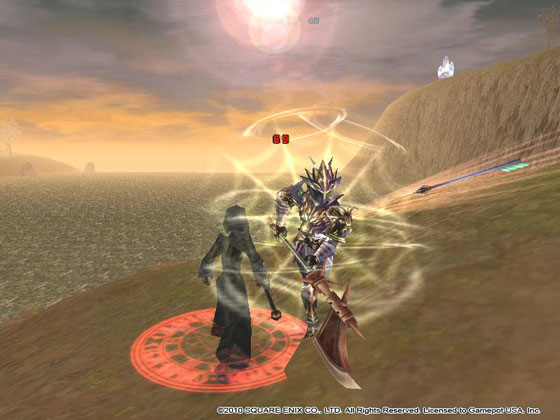
Square Enix and Gamepot have teamed up to bring us Fantasy Earth Zero. It’s not Final Fantasy and it’s not Earth (as far as I can tell) but it’s far from zero. When you first step into the game you’ll choose from one of three classes - Scout, Sorcerer and warrior. I chose a Scout for starters.
Obviously scouts are ranged types, warriors are melee types and sorcerers are magic types. In regards to races you’ve only got one, Human. But you can choose your gender. Once you’ve got your character sorted you then move on to faction choice. There will be five, but at present are only two. This will simply give you a nation to belong to so that you know whom to fight for territory which is one of the underlying mechanics of the game.
Honestly, I’m a bit disappointed in what the game looks to be offering. I had expected far more, some massively interesting story, some unique battle system or some outstanding environments. Instead there are severely restricted environments in which you can’t even meander through the forest which give it a sort of MMO on rails feel. The graphics aren’t that outstanding either and the character models are blocky. The faces look like masks hastily slapped onto polygonal heads and they’re generally less than what one would expect from the likes of Square Enix.There’s a lot of walking to and fro, as in many MMOs. Fantasy Earth Zero doesn’t give you a run option and there’s no auto-walk so that means you have to spend a lot of time just holding down a movement button going from point A to point B making the game very dull and boring at times. Aha, I found the autorun (it’s not on the in-game controls chart).
Even in many of the instanced areas you’re pretty much walking from encounter area to encounter area. The listed features on the main site say "attack, jump, dodge, run and experiece fast-paced, exciting combat." Well, there’s attack, jump, dodge at least.
The game uses what appear to be multiplayer instances called fields. However, there seem to be some problems with this at present where you cannot always create a field in order to complete a quest. I’m sure it’s just some technical problem that they will sort out over the course of the testing phases.
Fantasy Earth Zero has a skill learning process, like many RPGs but it’s limited to pretty much just attacks from what I’ve seen. My scout does also have the ability to hide but other than that, after seven levels of progress, it’s all attack skills. That seems quite one-dimensional to me. I have yet to see any kind of crafting in the game as well so it looks to be a mostly PvP-focused affair after you grind through enough levels to get into that facet of the game.
There are loads of NPCs just standing idly by waiting to chat with you. Which one sells something that is of use to you? Oh well you won’t know that without actually talking to them. That then means that you need to wander about until you find the right person for what you’re hoping to accomplish because each sells class specific gear instead of one big shop with all of it.
There are some interesting mission types that play into the fight for territory. When you are on a field with a tower you can build obelisks which then expand the territory under your control. As you gain more and more territory you do damage to the opponent’s tower until it is destroyed. But you can’t get to these missions until you’re of a certain level and that means a lot of mindless grinding until you can do something more interesting. A very limiting feature I must say.
If the whole point of the game is to take place in these battles for territory, then hindering your ability to participate in them seems counter-productive to me. Plus, insisting that you grind and grind just to get to them also sort of makes the game less fun. It’s sort of like saying, here’s this really good key lime pie, but first you have to eat this huge pile of stale biscuits.
Now I did manage to get into a battlefield, and was unable to do damage to the creatures inhabiting it, which of course meant a very quick death for me. I’m not sure if that was a technical glitch and that at such a low level I shouldn’t have been in that area or something else. But I hit them with my skill-powered attacks and did zero damage.
Overall, I think the game has a long way to go before it’s both ready for gamers and worth the time investment. That’s not to say it won’t be either. Just right now I felt like it was too much running around and not enough payoff.
Tuesday, May 11, 2010
Age of Conan: Rise of the Godslayer
Review:
While I'm not the Conan expert Rob is, maybe that's no bad thing. At the beginning of last year (when Funcom posted losses of $23 million) Conan's subscribers were estimated to have dropped below 100,000, and it's anyone's guess where that figure is today. So, in all probability, you're the same as me: a thousand miles away from Rob's rippling virtual muscles and proud collection of "alts", and simply curious as to whether Rise of the Godslayer makes Age of Conan something worth playing - or returning to.
On paper, things look pretty grim. Rise of the Godslayer doesn't feature the level cap increase you might expect from a serious £20 expansion, nor does it feature any new classes (not that Conan necessarily needed any, but still). Godslayer is actually meant to address the most significant criticism levelled at Conan - the same lack of content that both drives players to make new characters when they hit the level cap of 80, and that makes playing the game through a second or third time a chore.
'Age of Conan: Rise of the Godslayer' Screenshot 1
In seeking to thicken the Age of Conan experience rather than lengthen it, Rise of the Godslayer introduces the sprawling province of Khitai, a war-torn land that repurposes the imagery of Chinese, Korean and Mongolian history. Despite the region of Khitai collapsing into bloodshed after King Conan accidentally mercy-killed their God, the place often feels less fantastical than you might expect from the Conan universe and more like a wild, uneducated stab at Chinese history with monsters doodled in the margins. Unimaginative pagodas, paddy fields and jade carvings make a poor substitute for the occasionally spectacular architecture of Age of Conan's other areas.
Khitai itself is exclusively for level 80s, but the approach to the Great Wall of Khitai (an area known as the Gateway to Khitai, but technically the territory of neighbouring Hyrkania) provides a massive area for levels 20 to 40 to quest in. Any concerns that Conan's quest zones were cramped have been rigorously addressed, with Hyrkania's sprawling grasslands providing ample space for several very different camps of quest-givers and their respective quests.
You've got the barbarous Hyrkanian nomads with their enormous coliseum-sized wagon, the ruined caravan that they just attacked with its angry, scared survivors, and the trading town that's sprung up around the Wall's gate. This is smart MMO design, crafting a sense of place and motion from three static settlements of NPCs.
And yet the decision to make Gateway to Khitai a level 20-40 area is a weird one. The lack of content that puts Conan players at risk of having to grind appears between levels 50 and 80, not 20 and 40. All Funcom has done with this new area is extend the joy that begins with the introductory island of Tortage, which takes players by the hand to level 20 with lots of love and attention to detail. Entertaining as Gateway to Khitai is, it's not going to cushion the disappointment of the game's final 30 levels that see you having to meticulously track down almost every single quest.
On paper, things look pretty grim. Rise of the Godslayer doesn't feature the level cap increase you might expect from a serious £20 expansion, nor does it feature any new classes (not that Conan necessarily needed any, but still). Godslayer is actually meant to address the most significant criticism levelled at Conan - the same lack of content that both drives players to make new characters when they hit the level cap of 80, and that makes playing the game through a second or third time a chore.
'Age of Conan: Rise of the Godslayer' Screenshot 1
In seeking to thicken the Age of Conan experience rather than lengthen it, Rise of the Godslayer introduces the sprawling province of Khitai, a war-torn land that repurposes the imagery of Chinese, Korean and Mongolian history. Despite the region of Khitai collapsing into bloodshed after King Conan accidentally mercy-killed their God, the place often feels less fantastical than you might expect from the Conan universe and more like a wild, uneducated stab at Chinese history with monsters doodled in the margins. Unimaginative pagodas, paddy fields and jade carvings make a poor substitute for the occasionally spectacular architecture of Age of Conan's other areas.
Khitai itself is exclusively for level 80s, but the approach to the Great Wall of Khitai (an area known as the Gateway to Khitai, but technically the territory of neighbouring Hyrkania) provides a massive area for levels 20 to 40 to quest in. Any concerns that Conan's quest zones were cramped have been rigorously addressed, with Hyrkania's sprawling grasslands providing ample space for several very different camps of quest-givers and their respective quests.
You've got the barbarous Hyrkanian nomads with their enormous coliseum-sized wagon, the ruined caravan that they just attacked with its angry, scared survivors, and the trading town that's sprung up around the Wall's gate. This is smart MMO design, crafting a sense of place and motion from three static settlements of NPCs.
And yet the decision to make Gateway to Khitai a level 20-40 area is a weird one. The lack of content that puts Conan players at risk of having to grind appears between levels 50 and 80, not 20 and 40. All Funcom has done with this new area is extend the joy that begins with the introductory island of Tortage, which takes players by the hand to level 20 with lots of love and attention to detail. Entertaining as Gateway to Khitai is, it's not going to cushion the disappointment of the game's final 30 levels that see you having to meticulously track down almost every single quest.
But let's say you do reach level 80, or already have a fully levelled character eager to come out of retirement. In that case the meat of Rise of the Godslayer's content, Khitai itself, is waiting for you. And I do mean meat. Massive, chewy, bloody meat.
Khitai is big enough to render the fact that Rise of the Godslayer doesn't include a level cap increase absolutely absurd. There are four huge, wide-open areas to explore, each as big as Gateway to Khitai, except with more dungeons. By Conan's standards, there's enough here to hypothetically nudge a player up to level 100, or perhaps even 110.
But then perhaps you wouldn't get to have as much fun with the Faction system, Funcom's attempt to ground the game's psychotic free-for-all PvP and reward repeat play-throughs. Khitai's populace is about as good at calm co-operation as your average Daily Mail headline, and every Khitan region is home to several warring factions keen to offer you quests and rewards that make will make you an enemy of another faction, and perhaps a target to all of its players. It's through factions that you'll acquire some of the epic loot that's your only real goal in Khitan, since you're not levelling up.
It's also through factions that you get access to another of Rise of the Godslayer's touted features, raising your own personal wolf or tiger from a cub to a mount. This takes the form of a long series of quests for either the Wolves of the Steppe (bandits) or Tamarin Tiger (warrior-cannibals - no relation to the Tamil Tigers, then). Both mounts look extraordinarily cool, but much like the loot you're scratching through Khitan for, they're perhaps unlikely to excite statistically.
Similarly appealing yet slightly underwhelming is the new Alternate Advancement system, which gives Godslayer players a second talent tree containing of passive buffs, combos, abilities and spells that has its "General" branch unlocked at level 20 and a second, class-specific branch opened up at level 80.
'Age of Conan: Rise of the Godslayer' Screenshot 3
Unlike Conan's existing Feat trees, Alternate Advancement isn't tied to your level. Instead, you progress through it using points earned in PvE and PvP, and eventually (at level 80) you get the option of switching from 'Points' to 'Time', meaning you can click on what you want in the AA tree and it fills up slowly whether you're logged in or not.
My guess is that Alternate Advancement was meant to fix the lack of momentum that dogs Conan by giving players more character progression, more often, and while it is a welcome system, it's perhaps not as effective as Funcom might have hoped. Addictive play in RPGs doesn't simply come from "dings", but from growing your character in meaningful ways.
Without wanting to be facetious, Diablo or Torchlight are overwhelmingly moreish despite giving you very few abilities, simply because when you do improve your character it's with a tough choice that results in a significant change you can see and feel right away.
Age of Conan already had redundant abilities and a wealth of tactical options, so with the addition of dozens more perks and powers, character advancement can begin to feel a little sordid. Dropping into one of the level 80 characters Funcom kindly provided me with, I found myself having to study four racks of abilities and stances with at least a dozen more powers sat eagerly in menus, waiting to be given slots. But then once I did figure out what I was doing I found I could slouch through every fight with the same series of combos.
Khitai is big enough to render the fact that Rise of the Godslayer doesn't include a level cap increase absolutely absurd. There are four huge, wide-open areas to explore, each as big as Gateway to Khitai, except with more dungeons. By Conan's standards, there's enough here to hypothetically nudge a player up to level 100, or perhaps even 110.
But then perhaps you wouldn't get to have as much fun with the Faction system, Funcom's attempt to ground the game's psychotic free-for-all PvP and reward repeat play-throughs. Khitai's populace is about as good at calm co-operation as your average Daily Mail headline, and every Khitan region is home to several warring factions keen to offer you quests and rewards that make will make you an enemy of another faction, and perhaps a target to all of its players. It's through factions that you'll acquire some of the epic loot that's your only real goal in Khitan, since you're not levelling up.
It's also through factions that you get access to another of Rise of the Godslayer's touted features, raising your own personal wolf or tiger from a cub to a mount. This takes the form of a long series of quests for either the Wolves of the Steppe (bandits) or Tamarin Tiger (warrior-cannibals - no relation to the Tamil Tigers, then). Both mounts look extraordinarily cool, but much like the loot you're scratching through Khitan for, they're perhaps unlikely to excite statistically.
Similarly appealing yet slightly underwhelming is the new Alternate Advancement system, which gives Godslayer players a second talent tree containing of passive buffs, combos, abilities and spells that has its "General" branch unlocked at level 20 and a second, class-specific branch opened up at level 80.
'Age of Conan: Rise of the Godslayer' Screenshot 3
Unlike Conan's existing Feat trees, Alternate Advancement isn't tied to your level. Instead, you progress through it using points earned in PvE and PvP, and eventually (at level 80) you get the option of switching from 'Points' to 'Time', meaning you can click on what you want in the AA tree and it fills up slowly whether you're logged in or not.
My guess is that Alternate Advancement was meant to fix the lack of momentum that dogs Conan by giving players more character progression, more often, and while it is a welcome system, it's perhaps not as effective as Funcom might have hoped. Addictive play in RPGs doesn't simply come from "dings", but from growing your character in meaningful ways.
Without wanting to be facetious, Diablo or Torchlight are overwhelmingly moreish despite giving you very few abilities, simply because when you do improve your character it's with a tough choice that results in a significant change you can see and feel right away.
Age of Conan already had redundant abilities and a wealth of tactical options, so with the addition of dozens more perks and powers, character advancement can begin to feel a little sordid. Dropping into one of the level 80 characters Funcom kindly provided me with, I found myself having to study four racks of abilities and stances with at least a dozen more powers sat eagerly in menus, waiting to be given slots. But then once I did figure out what I was doing I found I could slouch through every fight with the same series of combos.
Phew, this is turning into a dismal review, isn't it? Let's talk about the strongest part of Rise of the Godslayer for a bit. Let's talk about Kara Korum, best of Khitai's four areas.
There are moments in Age of Conan when the game abruptly blindsides you with a vision of how awesome this MMO could have been - usually by grabbing hold of the Conan universe's lore and thrusting it at you with both hands. Arriving in the beautiful city of Tarantia where King Conan rules is one of these moments. Another is the entirety of Kara Korum.
Kara Korum is a region sat on the edge of the abyss. A vast crater containing some impossible, venerable evil lies to the North East, and the surrounding land wrestles with its taint on a daily basis. Locals have become warped, the flesh on their faces stretching to cover their eyes and mouths. Children sing songs of praise that nobody taught them under skies exhausted by perpetual lightning. A river of black fluid runs from the crater into a nearby lake, causing animals to grow to the size of trees, and trees to grow to the size of mountains. That place is now known as the Valley of the Gods. In the middle of Kara Korum sits a hermit living in the stinking ribcage of some long-dead behemoth; he explains that he heard the evil speak to him in the womb, and he's merely trying to return there.
Your faction choices in Kara Korum are The Last Legion, a miserable force of soldiers who pass the time by burning the dead and rushing to the defences whenever the crater burps out another wave of horrors, and the Scarlet Circle, a tiny group of scheming sorcerers perched in a fort built into the rim of the crater itself.
'Age of Conan: Rise of the Godslayer' Screenshot 4
There are moments in Age of Conan when the game abruptly blindsides you with a vision of how awesome this MMO could have been - usually by grabbing hold of the Conan universe's lore and thrusting it at you with both hands. Arriving in the beautiful city of Tarantia where King Conan rules is one of these moments. Another is the entirety of Kara Korum.
Kara Korum is a region sat on the edge of the abyss. A vast crater containing some impossible, venerable evil lies to the North East, and the surrounding land wrestles with its taint on a daily basis. Locals have become warped, the flesh on their faces stretching to cover their eyes and mouths. Children sing songs of praise that nobody taught them under skies exhausted by perpetual lightning. A river of black fluid runs from the crater into a nearby lake, causing animals to grow to the size of trees, and trees to grow to the size of mountains. That place is now known as the Valley of the Gods. In the middle of Kara Korum sits a hermit living in the stinking ribcage of some long-dead behemoth; he explains that he heard the evil speak to him in the womb, and he's merely trying to return there.
Your faction choices in Kara Korum are The Last Legion, a miserable force of soldiers who pass the time by burning the dead and rushing to the defences whenever the crater burps out another wave of horrors, and the Scarlet Circle, a tiny group of scheming sorcerers perched in a fort built into the rim of the crater itself.
'Age of Conan: Rise of the Godslayer' Screenshot 4
Exploring Kara Korum, it's hard not to feel an electric fluttering of excitement in your chest, an excitement I feel that most of Age of Conan, for all of its hearty competence, sorely lacks. Forming a group and going roaring into the crater to assault one of its three dungeons is a hugely dramatic experience, not least because the closer you get to the crater, the more the Taint debuffs your character and the more your surroundings become very unsettling indeed.
It's unfortunate that Kara Korum is a high point buried amid more dreary content. As such, if you're looking for a reason to get involved in Age of Conan, Rise of the Godslayer almost certainly isn't it.
As for former players thinking of returning to Hyboria, well, I'd just offer one point: most of Conan's free updates after its launch concerned themselves with adding content that should have been there in the first place. What Rise of the Godslayer adds is comparable to what World of Warcraft or Lord of the Rings Online put out in their first two years, for free. (It's also worth pointing out that on the beta server I played Godslayer on, the memory leaks and general instability of the client were still an issue, and crashes were regular, although Funcom assures us things will improve in the live version of the game.)
It's unfortunate that Kara Korum is a high point buried amid more dreary content. As such, if you're looking for a reason to get involved in Age of Conan, Rise of the Godslayer almost certainly isn't it.
As for former players thinking of returning to Hyboria, well, I'd just offer one point: most of Conan's free updates after its launch concerned themselves with adding content that should have been there in the first place. What Rise of the Godslayer adds is comparable to what World of Warcraft or Lord of the Rings Online put out in their first two years, for free. (It's also worth pointing out that on the beta server I played Godslayer on, the memory leaks and general instability of the client were still an issue, and crashes were regular, although Funcom assures us things will improve in the live version of the game.)
Labels:
Massively Multiplayer,
New Releases,
PC Games,
Review,
Role-Playing
Tuesday, April 20, 2010
Sherlock Holmes vs. Jack the Ripper
Hunt for the most dangerous serial killer in England's history in Sherlock Holmes vs. Jack the Ripper.
Showing amazon results for "Sherlock Holmes vs. Jack the Ripper"
Sherlock Holmes vs. Jack the Ripper Official Trailer
Sunday, April 11, 2010
Splinter Cell: Conviction
Splinter Cell: Conviction Review

Sam Fisher is back, and he is not in a good mood. Of all the smart decisions made in crafting a new Splinter Cell title, this might be the best one developer Ubisoft Montreal made. Sam's angry and you hear it in every grunted line of dialogue, can see it in the brutal takedowns and interrogation moves and feel it pulsating through Sam with every step. That anger, that aggressiveness is built not only into the story but the gameplay changes as well. It was a huge risk deviating from the trial-and-error style that made the series famous, but it paid off. Splinter Cell Conviction is awesome.
The story takes place a few years after the end of Splinter Cell: Double Agent. Don't worry, if you never finished that game, you'll get caught up quickly as to what's going on. Sam's daughter was killed, he murdered his best friend Lambert, and he split from Third Echelon, the government agency he'd called home for years. With new evidence leading to his daughter's killer, a tormented and semi-retired Sam Fisher is called back into action. Turns out the people responsible for his daughter's fate are planning a major terrorist attack on Washington D.C. This is going to be one long day for Jack Bauer Sam Fisher.
Conviction sets itself apart from its predecessors with its pacing. You're always being pushed forward, so much so that I played through the entire single-player campaign in one sitting without even realizing I'd been up all night. Ubisoft pulled off a few magic tricks to make this happen.
There are no in-game loading screens unless you die. From the moment the game starts, you never sit around waiting for something to happen. Levels are loaded while you're watching slickly presented cutscenes. Fancy new projection technology integrates text into the scenery to point you towards your goal, and back story is shown with movies playing out on walls as you progress through a level. These things aid in keeping players immersed in the world, but the real reason things feel so fluid is the change in approach to stealth.
In Conviction, stealth is about speed.
Sam moves fast. Really fast. He can get in and out of cover quickly, shimmy across ledges faster than the Prince of Persia and beat a hasty retreat if he gets into trouble. Sam's codename used by Third Echelon is "panther," and that's fitting. In past Splinter Cell games, enemies were meant to be avoided; in Conviction, Sam is a hunter. He isn't avoiding enemies, he's stalking them.
Sam lurks in the shadows, finds his moment to pounce and strikes with deadly efficiency. There may be a dozen men, fully armed and with extensive combat training closing in, but they're the ones who should be worried. You feel like the ultimate badass thanks to some generous aiming assists that let you easily put bullets into approaching enemy noggins.
Rather than force players to eyeball a variety of meters to determine their level of stealth, Ubisoft made things very obvious. If you're in the shadows and impossible to see, the color bleeds out and things go black and white. The minute you're in the light, the color comes back. This easy sense of whether you are hidden or exposed enables you to move quickly through the environment and plan your route of attack on the fly.
Shadows and light are just half the stealth equation. The other half is the cover system. The cover is not at all like Gears of War, where you're sucked against a wall. Squeeze the left trigger and if you are near an object, you'll take cover behind it. Release the trigger and you immediately disengage, or you can hold down the trigger and move away from cover with no problem. You're never attached to a surface. In fact, you can hold down the trigger when out in the open and Sam will crouch, doing his best to minimize his visibility.
This is the best cover system I've ever used. Every other game needs to change, because I can't go back.
Should you be spotted, the best thing to do is retreat. Get out of sight and a white silhouette appears, marking your Last Known Position. The AI will focus on this spot, because it's where they think you're hiding. They'll unload some shots, maybe toss a grenade and then make their way towards the spot to see if they got you. On Realistic difficulty -- the only way you should play Conviction -- the AI is very sharp and won't be fooled for long. You can use the Last Known Position to your advantage. Flank your enemies when their attention is on your silhouette, then take them out before they realize what's going on.
Using shadows and cover, you stalk your prey, and when you're close enough, you can perform a hand-to-hand takedown. There are dozens (probably more than a hundred) of these. They're an excellent reward for being sneaky. My favorite is shooting a guy in the leg and as he crumples downward, popping him in the chin with my silenced pistol. But the system isn't perfect. You bash in a door with the same button as a hand-to-hand takedown. Attempt to quietly kill an enemy near a door and you may end up kicking in the door and causing a ruckus. Occasional glitches aside, stealth kills look cool, avoid attracting attention and earn you the ability to execute.
The Mark & Execute system is probably the most controversial change to the Splinter Cell series. You can tag or "mark" enemies, putting a big arrow over their heads and then executing them with the press of a button. So long as the mark is red, you are guaranteed a kill. As it's described, this would seem like a "win" button that would make Splinter Cell too easy. Far from it. You have to work to earn the right to execute. Use it once and you must perform another stealth takedown to activate the execution option again. More importantly, executing does not equal "stealthily execute." If you aren't careful, you can easily expose yourself to enemies when you enter execution mode. There are often more enemies than you could ever mark, so it's not as if you run through tagging and killing with ease.
Each weapon has its own unique properties, including the number of available marks. This is a great way to balance the game while adding a bit of strategy to how you gear up before heading into action. Do you take the low-powered Five-Seven pistol because it has the most marks (four) or do you up your firepower to another gun, sacrificing the marks?
Mark & Execute is a great addition and doesn't ruin Splinter Cell in any way. The only drawback is that sometimes you'll hit Execute and a targeted enemy will pass behind a wall. You'll still score the kill, but your bullet with defy physics and phase through the obstruction to hit your target.
All of these new gameplay elements are quickly explained in the single-player campaign. These things are so intuitive, that the tutorial is over before you know it. The campaign is a brisk and enjoyable five-hour experience that has only two odd spots.
Early on, there is a flashback to 20 years ago in Iraq. Out in broad daylight, all stealth is eliminated and Splinter Cell becomes nothing more than a third-person shooter. The other section that sticks out is an area where, if spotted, you fail the mission. What a bad idea. This is what Splinter Cell: Chaos Theory fixed five years ago. Who wants instant-fail gameplay?
While the single-player campaign won't take long to beat, even on Realistic difficulty, it's just one piece of the larger package. There's a ton of content in Conviction: a totally separate co-op campaign, Hunter, Infiltration, and Last Stand modes. Plus, there's an an in-game challenge system to test your stealth skills.
The co-op is well worth discussing. It is, after all, better than the single-player campaign. Offering split-screen, System Link and online support, you and a friend take on the roles of Third Echelon agent Archer and Russian Voron agent Ketrel. The co-op story is a prequel to the single-player campaign and has the two teaming up to hunt down some missing WMDs. While both Archer and Kestrel have the same moves as Sam, they must work together to make it through four unique environments.
Live together or die alone. That's the motto for Splinter Cell's co-op. If your friend dies, the mission fails. That means you must watch each other's back. Fortunately, you can heal your fallen friend before he bleeds out. And if your pal is careless and gets grabbed by an enemy, he can elbow his captor's face to gain a bit of separation before you cap him.
The ultimate joy of co-op is marking and executing enemies in tandem. Archer and Kestrel share their marks. So even if your buddy marks someone, if you have the angle, you can hit the execute button to take them down. When you both have line-of-sight on marked enemies, time slows down for a few seconds after an execution move begins. If your friend taps the execute button, he can join in. This often leads to double-shots to a villain's dome.
There are no in-game loading screens unless you die. From the moment the game starts, you never sit around waiting for something to happen. Levels are loaded while you're watching slickly presented cutscenes. Fancy new projection technology integrates text into the scenery to point you towards your goal, and back story is shown with movies playing out on walls as you progress through a level. These things aid in keeping players immersed in the world, but the real reason things feel so fluid is the change in approach to stealth.
In Conviction, stealth is about speed.
Sam moves fast. Really fast. He can get in and out of cover quickly, shimmy across ledges faster than the Prince of Persia and beat a hasty retreat if he gets into trouble. Sam's codename used by Third Echelon is "panther," and that's fitting. In past Splinter Cell games, enemies were meant to be avoided; in Conviction, Sam is a hunter. He isn't avoiding enemies, he's stalking them.
Sam lurks in the shadows, finds his moment to pounce and strikes with deadly efficiency. There may be a dozen men, fully armed and with extensive combat training closing in, but they're the ones who should be worried. You feel like the ultimate badass thanks to some generous aiming assists that let you easily put bullets into approaching enemy noggins.
Rather than force players to eyeball a variety of meters to determine their level of stealth, Ubisoft made things very obvious. If you're in the shadows and impossible to see, the color bleeds out and things go black and white. The minute you're in the light, the color comes back. This easy sense of whether you are hidden or exposed enables you to move quickly through the environment and plan your route of attack on the fly.
Shadows and light are just half the stealth equation. The other half is the cover system. The cover is not at all like Gears of War, where you're sucked against a wall. Squeeze the left trigger and if you are near an object, you'll take cover behind it. Release the trigger and you immediately disengage, or you can hold down the trigger and move away from cover with no problem. You're never attached to a surface. In fact, you can hold down the trigger when out in the open and Sam will crouch, doing his best to minimize his visibility.
This is the best cover system I've ever used. Every other game needs to change, because I can't go back.
Should you be spotted, the best thing to do is retreat. Get out of sight and a white silhouette appears, marking your Last Known Position. The AI will focus on this spot, because it's where they think you're hiding. They'll unload some shots, maybe toss a grenade and then make their way towards the spot to see if they got you. On Realistic difficulty -- the only way you should play Conviction -- the AI is very sharp and won't be fooled for long. You can use the Last Known Position to your advantage. Flank your enemies when their attention is on your silhouette, then take them out before they realize what's going on.
Using shadows and cover, you stalk your prey, and when you're close enough, you can perform a hand-to-hand takedown. There are dozens (probably more than a hundred) of these. They're an excellent reward for being sneaky. My favorite is shooting a guy in the leg and as he crumples downward, popping him in the chin with my silenced pistol. But the system isn't perfect. You bash in a door with the same button as a hand-to-hand takedown. Attempt to quietly kill an enemy near a door and you may end up kicking in the door and causing a ruckus. Occasional glitches aside, stealth kills look cool, avoid attracting attention and earn you the ability to execute.
The Mark & Execute system is probably the most controversial change to the Splinter Cell series. You can tag or "mark" enemies, putting a big arrow over their heads and then executing them with the press of a button. So long as the mark is red, you are guaranteed a kill. As it's described, this would seem like a "win" button that would make Splinter Cell too easy. Far from it. You have to work to earn the right to execute. Use it once and you must perform another stealth takedown to activate the execution option again. More importantly, executing does not equal "stealthily execute." If you aren't careful, you can easily expose yourself to enemies when you enter execution mode. There are often more enemies than you could ever mark, so it's not as if you run through tagging and killing with ease.
Each weapon has its own unique properties, including the number of available marks. This is a great way to balance the game while adding a bit of strategy to how you gear up before heading into action. Do you take the low-powered Five-Seven pistol because it has the most marks (four) or do you up your firepower to another gun, sacrificing the marks?
Mark & Execute is a great addition and doesn't ruin Splinter Cell in any way. The only drawback is that sometimes you'll hit Execute and a targeted enemy will pass behind a wall. You'll still score the kill, but your bullet with defy physics and phase through the obstruction to hit your target.
All of these new gameplay elements are quickly explained in the single-player campaign. These things are so intuitive, that the tutorial is over before you know it. The campaign is a brisk and enjoyable five-hour experience that has only two odd spots.
Early on, there is a flashback to 20 years ago in Iraq. Out in broad daylight, all stealth is eliminated and Splinter Cell becomes nothing more than a third-person shooter. The other section that sticks out is an area where, if spotted, you fail the mission. What a bad idea. This is what Splinter Cell: Chaos Theory fixed five years ago. Who wants instant-fail gameplay?
While the single-player campaign won't take long to beat, even on Realistic difficulty, it's just one piece of the larger package. There's a ton of content in Conviction: a totally separate co-op campaign, Hunter, Infiltration, and Last Stand modes. Plus, there's an an in-game challenge system to test your stealth skills.
The co-op is well worth discussing. It is, after all, better than the single-player campaign. Offering split-screen, System Link and online support, you and a friend take on the roles of Third Echelon agent Archer and Russian Voron agent Ketrel. The co-op story is a prequel to the single-player campaign and has the two teaming up to hunt down some missing WMDs. While both Archer and Kestrel have the same moves as Sam, they must work together to make it through four unique environments.
Live together or die alone. That's the motto for Splinter Cell's co-op. If your friend dies, the mission fails. That means you must watch each other's back. Fortunately, you can heal your fallen friend before he bleeds out. And if your pal is careless and gets grabbed by an enemy, he can elbow his captor's face to gain a bit of separation before you cap him.
The ultimate joy of co-op is marking and executing enemies in tandem. Archer and Kestrel share their marks. So even if your buddy marks someone, if you have the angle, you can hit the execute button to take them down. When you both have line-of-sight on marked enemies, time slows down for a few seconds after an execution move begins. If your friend taps the execute button, he can join in. This often leads to double-shots to a villain's dome.
Grand Theft Auto IV: Episodes from Liberty City
Release Date: Apr 13, 2010Grand Theft Auto: Episodes From Liberty City is a stand-alone game featuring The Lost and Damned and The Ballad of Gay Tony episodes on one disc.
Genre: Action Adventure
* Rockstar Games
* Rockstar North
* Modern Action Adventure
* Release: Apr 13, 2010 »
* ESRB: Mature
more Info
Rig'n'Roll
Rig'n'Roll Reviews:Rig 'n' Roll Hands-On Impressions
Let’s face it, everyone has dreamed about becoming a professional trucker at some point in their lives. Hitting the open road for days on end, driving the world’s most exciting stretches of arrow-straight freeways, and sleeping on an inflatable mattress in the back of a cab littered with empty Red Bull cans is the stuff you dreamt about as a child. Even though real life may have caught up with you, now you’ll be able to live out those childhood fantasies in a new game called Rig 'n' Roll from Russian publisher 1C. We recently traveled all the way to GamesCom in Cologne to see what this trucking simulator has to offer.

In Rig 'n' Roll, the year is 2024 and you’ve got a simple mission: Drive from Point A to Point B to deliver the goods in the back of your truck. A lot. All over the state of California. This futuristic version of California isn’t some sci-fi wasteland, though. It looks very much like the California of today. In fact, the game features a scaled map of California (and some parts of Nevada) containing 42 towns from San Diego to Eureka way up north. Connecting these locales is a 12,000-mile collection of rolling highways and byways that can be as dense as those in Los Angeles or as painfully lonely as those outside Bakersfield.
The game offers the ability to play over the course of a campaign or jump straight into a timed delivery route via the instant order mode. The campaign doesn’t have any sort of dramatic storyline of going from trucking rags to trucking riches--you’re simply out to do your best and get the job done as consistently as possible. Each job you take on gives you a specified delivery point on the map and a set number of times to get there. The route you take to get there is up to you. But unlike a traditional racing game, here you’ll have to obey not only the posted speed limit, but also basic traffic laws, such as passing on the left and making sure not to commit illegal turns. If you violate these rules, you’ll have the cops come after you in a way 1C compared to the Need for Speed series.

The driving and sense of speed aren’t exactly Need for Speed, though. The trucks lumber along with the stiffness and delayed acceleration of any giant rig carrying multiple tons of cargo, and the feeling of movement--at least in the early build we played--was hampered quite a bit by a chunky frame rate. Still, the graphics are solid if a little unremarkable, which seems fine considering how much real estate the game’s map of California offers. No release date has been announced for Rig 'n' Roll, but it’s most likely due to arrive early next year.
1C Previews - Many PC and Console Games from Russia
At a recent press event held by Russia-based publisher 1C, we had a chance to see and try out a fistful of new games for both the PC and consoles. Here's a blow-by-blow report on what we saw:

Men of War: Red Tide - We played this briefly. This expansion pack to the original World War II game will offer more small-scale, small-arms tactical strategy. This time around, you control a small squad of Russian marine commandos in a variety of assault missions against German occupation armies on the Eastern Front. The level we played put us in command of a handful of soldiers of different professions (such as officer, rifleman, submachine gun support, and sniper) taking on a night mission in a German-occupied shipyard. We found ourselves landed on the beach, trying to carefully inch our squadron forward while periodically coming under fire by soldiers hidden behind cover. Fortunately, because we were on the docks, there was plenty of cover for our troops--stacks of crates, barrels, and fishing nets for us to hover our mouse over before our next move to pull up silhouettes, which indicated where our soldiers would end up relative to cover. We attempted to finesse our way across the dock by sending in our assault-oriented troops in first to draw fire while we leapfrogged our sniper into position behind higher cover, but this didn't seem to work well, since we encountered new pockets of hidden soldiers with pretty much every significant forward move we made. If the first mission is any indication, Red Tide seems like it may be less about stealth and more about getting into firefights early and often. The game will be released later this year.

XIII Century: Blood of Europe - We played this briefly. This follow-up to XIII Century will, like the previous game, offer large-scale tactical battles reminiscent of the Total War series. This time around, the campaign focuses on Dovmont, the prince of Pskov in the region known as "Northern Rus" (present-day Russia), who must repel the attacks of powerful, well-armed Teuton invaders. The quick battle we jumped into was part of the ongoing "Europe at War" play mode (the game will also have a separate campaign mode as well as a "custom game" mode). Like in XIII Century, in Blood of Europe, you'll have a brief respite before each battle to choose your forces before heading out to the field. In our case, because we were basically starting a new game from scratch, we had only the funds to hire three mounted companies; a lancer company, an archer company, and a swordsman company, and we were greatly outnumbered by the Teutons. Once we were done deliberating, we moved out to the field where our tiny army stood at the ready, with the real-time battle defaulting to "paused." We then unpaused the game using the "unpause" button from the icon-and-button-stuffed interface menu in the lower-left corner of the screen (which also has buttons for grouping, company orders, formations, and dozens of other things) and led our units forward to the enemy, which lay in wait on the other side of a shallow swamp surrounded on the edges by heavy forest and a small foothill off to the side. Sadly, our elegant stratagem of sneaking our archers to the high ground to pelt our enemies with arrows didn't quite work since or enemies caught wind of us before we were all the way around the foothill. They rushed us through the nearby forest and quickly surrounded our melee companies, but hovering our mouse over the armies helpfully displayed dozens of different statistics about each battalion--weapon status, armor, skill, morale, flank status, rear status, and so on before we unleashed the ultimate stratagem to prevent defeat--quitting out back to the main menu (after all, it was a big event with a lot of games, and we were pressed for time...and we're sticking to that story). Blood of Europe will be released later this year.

IL-2 Sturmovik: Birds of Prey for Xbox 360 / PS3 - We played this briefly. Despite the game's name, it has little or nothing to do with the original IL-2 Sturmovik combat flight simulator for the PC from 2001, except that this game is also about flying fighter plans in World War II. However, Birds of Prey has a much more-forgiving control scheme that's better suited to a console controller, and also offers two different "realism" levels--the default arcade-style mode that has the easiest handling, and a more-realistic mode (which we did not try) that has more-challenging plane physics and also requires you to worry about things like your ship's fuel supply. The left analog stick controls your ship's bearing (nose up, nose down, wings up and down) while the right analog stick controls the throttle, and with the exception of suddenly losing forward momentum by pulling up to high in the air, or twirling around too low to the ground and crashing, there probably won't be too many hazardous accidents for players who are serious enough to hunker down and try to wrap their heads around the game's control scheme. The mission we played was in a dogfighting ship equipped with wing-mounted machineguns to fly into enemy territory and try to repel an enemy squadron of similarly equipped fighter planes. The level seemed to do a good job of pacing the encounters for newer players, first throwing only a couple of advance scouts at us so that we could get used to the back-and-forth airborne jousting you'll be doing a great deal of in the game, following blinking indicator arrows onscreen to the location of your nearest enemy, or nearest mission objective, or even your nearest ally. Yes, some missions will actually offer computer-controlled allied planes that seem to fly quite competently and are even pretty good shots, though with persistence and a mindful eye to keep our ship well above the ocean below us, we were able to eventually bring down a few enemy fighters ourselves. However, this action came after a long flight out from base over the ocean to eventually arrive in enemy territory--much like the action in many World War II campaigns, which occasionally required long, uneventful, from-point-A-to-point-B air trips before seeing any action, so it's not clear that Birds of Prey will be a quick pick-up-and-put-down game for 15 minutes on the sofa. The game is scheduled for release later this year.

Majesty 2: The Fantasy Kingdom Sim - We played this briefly. For those unfamiliar, this is the sequel to the cult-classic, Majesty: The Fantasy Kingdom Sim, a role-playing/strategy hybrid with the unique distinction of having heroes who went on quests, gained experience levels, hunted for treasure, and so on, but not under your direct control. Like in the original game, in Majesty 2, you build up a kingdom, but the actual business of heroically sallying forth and slaying monsters is left up to heroes on their own time. Starting a new game of Majesty 2, we began by building defense towers around our starting keep to safeguard it from rampaging monsters, then started to build guild structures that recruit heroes, such as rangers (who are dynamite archers) and priests (who can cast healing spells). Once we built our guilds and cranked out our first heroes, we set about our task of exploring the wilderness, then clearing out the wolf's den that lay just southwest of our little burg. In situations like this, your best hope to explore the fog-of-war-obscured map, clear out monster nests, and rescue the princess(es) is to place a bounty of gold on these tasks by setting down either an explore flag or a conquer flag in these areas, and affixing whatever gold bounty you consider to be fair. We laid down a few explore flags to help clear out the fog, then dropped a hunting bounty on the den of those pesky wolves and placed a bounty of a couple hundred gold pieces. Once you lay out a bounty and incentivize it, you can mouse over that bounty's flag to see (and change) its current gold bounty price, as well as see how many active heroes are "interested" in taking on the task. In our case, both our ranger and our priest heroes were interested, and trotted out to the den to began whaling on the wolves and their cave. In the meantime, we built up a marketplace at our starting keep to promote commerce and bring in more gold--as you progress through the game, you'll be able to offer bounties to much more-powerful heroes to perform much more-heroic tasks, but it'll cost you. From what we've played, Majesty 2 seems like it stays true to the original game while offering a colorful, 3D graphics makeover. The game will ship later this year.

King's Bounty: Armored Princess - We played this briefly. Armored Princess is the follow-up to last year's King's Bounty: The Legend, which is itself a spiritual successor to the classic Heroes of Might and Magic turn-based fantasy strategy series. Like last year's King's Bounty, Armored Princess is a fully 3D game that takes place in a colorful fantasy world populated by knights, wizards, and lots of different monsters. These fantastical denizens live in different keeps, each of which gives rise to a different set of critters which can be recruited to your cause, though to reap the spoils of war, you must first conquer these keeps and any wandering monsters that guard them. You do so in turn-based battles that take placed on a hex grid and, like in Heroes of Might and Magic, each company of monsters in your employ appears in battle, can move a certain number of hexes per turn, attack at melee range (at the risk of suffering a counterattack from the defending forces), and may have different abilities in battle that will give your team an edge, such as ranged attacks from dwarven cannoneers, or a powerful charging attack from mounted horsemen. In the game, you play as the titular Armored Princess Amelie, who rides her wondrous flying horse (you can press the "F" key to toggle flying on and off) on a quest to find her missing mentor, the mighty hero Bill Gilbert (we know, right?), and to find Bill, you'll need to explore overland maps, picking up piles of treasure and magical items along the way and doing plenty of turn-based fighting. Armored Princess looks like it'll offer even more colorful, fantasy-themed turn-based strategy, and for fans of this sort of thing, things could be a lot worse. The game will ship this Christmas.

Death to Spies: Moment of Truth - We played this briefly. Moment of Truth is the follow-up to 2007's Death to Spies, and like the original game, you play as a covert operative from the perspective of a third-person shooter. However, this isn't a game about running and gunning--in fact, if your enemies sight you, there's a good chance you're already a dead man. Instead, Moment of Truth is about sneaking through each level in the hopes of going undetected to reach your objective. Like in the previous game, you'll have a big bag of tricks to help you, including different weapon loadouts you can choose at the outset of each mission (like a silenced Sten submachine gun and a silenced handgun), a knife for silent kills, chloroform to knock out enemies, and a variety of grenades. There are also multiple postures you can take on the move--walking, crouching, and prone, and while the game has keyboard shortcuts for each, you can also handily switch your posture on the fly with your mousewheel the moment you sight trouble. We played through a bit of the first mission, which required us to sneak along a wooded path to rescue some captured scientists. At any point in the mission, you can press the "O" key to bring up your mission briefing to refresh your memory as well as to locate yourself on a handy map relative to your goal. Since the forest was actually structured like a shallow basin with the open road being the lowest (and most conspicuous) level, we carefully tried to stay halfway between the road and the forest and grass to get the most cover, though we were sighted by groups of enemy soldiers several times and had our heads handed to us once or twice. Because Moment of Truth is a stealth-based game, there's a "detection" meter that sits at the top of the screen that shows how aware your enemies are of your presence; if they barely catch a glimpse of you and you hightail it out of there through cover, the meter will eventually empty out and you'll be in the clear. However, if you get close enough to engage in battle and pull your gun, they'll generally pursue you, which makes it difficult to impossible to escape their notice again. Death to Spies: Moment of Truth is scheduled for release later this year.

Rig'n'Roll - We unfortunately didn't get a chance to try playing this one, but we did get a good look at it. Rig'n'Roll is 1C's ambitious (and long-in-development) trucking simulation, which will let you drive a truck to run races in racing minigames, ship out freight from location to location, and eventually build up your own trucking empire as you hire additional truckers to join your operation and haul oranges, hats, car parts, hats, women's shoes, and hats all across the Golden State. The game will model the entire geography of the state of California and all its highways (presumably the maddening choke of rush-hour traffic on such commute-heavy thoroughfares as the I-80 near the Bay Bridge and the 101 near the San Jose corridor will not appear in the game), and support high-end PC driving peripherals if you happen to have them. While you drive, Rig'n'Roll will offer multiple viewing perspectives (such as a third-person behind-the-truck view, a driver's seat view, and a first-person view), a few gadgets to play with (such as the windshield wipers if it happens to be raining--the game will have day/night cycles and the kind of weather conditions you'd expect to see in sunny California), and continuous radio chatter from your fellow trucking employees and the beautiful young female dispatcher who will update you on your missions. Rig'N'Roll is scheduled for release this year.

Captain Blood for Xbox 360 / PS3 / PC - We unfortunately didn't get a chance to try playing this one, but it appears to be a third-person action game reminiscent of the recent Prince of Persia games or the God of War series, in that you have a relatively nimble protagonist armed with a melee weapon (in this case, a gleaming curved cutlass) and can press your attack button repeatedly to perform combination melee attacks against your enemies, which appear include rival pirates and the local constabulary. You play as the titular sea captain, star of author Rafael Sabatini's swashbuckling novels, and both explore land areas and manage ship-to-ship combat by taking manual control of the cannons on your ships and firing on enemy ships with the aid of glowing onscreen arcs. The game will be released on the PC and the Xbox 360 this year.
Let’s face it, everyone has dreamed about becoming a professional trucker at some point in their lives. Hitting the open road for days on end, driving the world’s most exciting stretches of arrow-straight freeways, and sleeping on an inflatable mattress in the back of a cab littered with empty Red Bull cans is the stuff you dreamt about as a child. Even though real life may have caught up with you, now you’ll be able to live out those childhood fantasies in a new game called Rig 'n' Roll from Russian publisher 1C. We recently traveled all the way to GamesCom in Cologne to see what this trucking simulator has to offer.

In Rig 'n' Roll, the year is 2024 and you’ve got a simple mission: Drive from Point A to Point B to deliver the goods in the back of your truck. A lot. All over the state of California. This futuristic version of California isn’t some sci-fi wasteland, though. It looks very much like the California of today. In fact, the game features a scaled map of California (and some parts of Nevada) containing 42 towns from San Diego to Eureka way up north. Connecting these locales is a 12,000-mile collection of rolling highways and byways that can be as dense as those in Los Angeles or as painfully lonely as those outside Bakersfield.
The game offers the ability to play over the course of a campaign or jump straight into a timed delivery route via the instant order mode. The campaign doesn’t have any sort of dramatic storyline of going from trucking rags to trucking riches--you’re simply out to do your best and get the job done as consistently as possible. Each job you take on gives you a specified delivery point on the map and a set number of times to get there. The route you take to get there is up to you. But unlike a traditional racing game, here you’ll have to obey not only the posted speed limit, but also basic traffic laws, such as passing on the left and making sure not to commit illegal turns. If you violate these rules, you’ll have the cops come after you in a way 1C compared to the Need for Speed series.

The driving and sense of speed aren’t exactly Need for Speed, though. The trucks lumber along with the stiffness and delayed acceleration of any giant rig carrying multiple tons of cargo, and the feeling of movement--at least in the early build we played--was hampered quite a bit by a chunky frame rate. Still, the graphics are solid if a little unremarkable, which seems fine considering how much real estate the game’s map of California offers. No release date has been announced for Rig 'n' Roll, but it’s most likely due to arrive early next year.
1C Previews - Many PC and Console Games from Russia
At a recent press event held by Russia-based publisher 1C, we had a chance to see and try out a fistful of new games for both the PC and consoles. Here's a blow-by-blow report on what we saw:

Men of War: Red Tide - We played this briefly. This expansion pack to the original World War II game will offer more small-scale, small-arms tactical strategy. This time around, you control a small squad of Russian marine commandos in a variety of assault missions against German occupation armies on the Eastern Front. The level we played put us in command of a handful of soldiers of different professions (such as officer, rifleman, submachine gun support, and sniper) taking on a night mission in a German-occupied shipyard. We found ourselves landed on the beach, trying to carefully inch our squadron forward while periodically coming under fire by soldiers hidden behind cover. Fortunately, because we were on the docks, there was plenty of cover for our troops--stacks of crates, barrels, and fishing nets for us to hover our mouse over before our next move to pull up silhouettes, which indicated where our soldiers would end up relative to cover. We attempted to finesse our way across the dock by sending in our assault-oriented troops in first to draw fire while we leapfrogged our sniper into position behind higher cover, but this didn't seem to work well, since we encountered new pockets of hidden soldiers with pretty much every significant forward move we made. If the first mission is any indication, Red Tide seems like it may be less about stealth and more about getting into firefights early and often. The game will be released later this year.

XIII Century: Blood of Europe - We played this briefly. This follow-up to XIII Century will, like the previous game, offer large-scale tactical battles reminiscent of the Total War series. This time around, the campaign focuses on Dovmont, the prince of Pskov in the region known as "Northern Rus" (present-day Russia), who must repel the attacks of powerful, well-armed Teuton invaders. The quick battle we jumped into was part of the ongoing "Europe at War" play mode (the game will also have a separate campaign mode as well as a "custom game" mode). Like in XIII Century, in Blood of Europe, you'll have a brief respite before each battle to choose your forces before heading out to the field. In our case, because we were basically starting a new game from scratch, we had only the funds to hire three mounted companies; a lancer company, an archer company, and a swordsman company, and we were greatly outnumbered by the Teutons. Once we were done deliberating, we moved out to the field where our tiny army stood at the ready, with the real-time battle defaulting to "paused." We then unpaused the game using the "unpause" button from the icon-and-button-stuffed interface menu in the lower-left corner of the screen (which also has buttons for grouping, company orders, formations, and dozens of other things) and led our units forward to the enemy, which lay in wait on the other side of a shallow swamp surrounded on the edges by heavy forest and a small foothill off to the side. Sadly, our elegant stratagem of sneaking our archers to the high ground to pelt our enemies with arrows didn't quite work since or enemies caught wind of us before we were all the way around the foothill. They rushed us through the nearby forest and quickly surrounded our melee companies, but hovering our mouse over the armies helpfully displayed dozens of different statistics about each battalion--weapon status, armor, skill, morale, flank status, rear status, and so on before we unleashed the ultimate stratagem to prevent defeat--quitting out back to the main menu (after all, it was a big event with a lot of games, and we were pressed for time...and we're sticking to that story). Blood of Europe will be released later this year.

IL-2 Sturmovik: Birds of Prey for Xbox 360 / PS3 - We played this briefly. Despite the game's name, it has little or nothing to do with the original IL-2 Sturmovik combat flight simulator for the PC from 2001, except that this game is also about flying fighter plans in World War II. However, Birds of Prey has a much more-forgiving control scheme that's better suited to a console controller, and also offers two different "realism" levels--the default arcade-style mode that has the easiest handling, and a more-realistic mode (which we did not try) that has more-challenging plane physics and also requires you to worry about things like your ship's fuel supply. The left analog stick controls your ship's bearing (nose up, nose down, wings up and down) while the right analog stick controls the throttle, and with the exception of suddenly losing forward momentum by pulling up to high in the air, or twirling around too low to the ground and crashing, there probably won't be too many hazardous accidents for players who are serious enough to hunker down and try to wrap their heads around the game's control scheme. The mission we played was in a dogfighting ship equipped with wing-mounted machineguns to fly into enemy territory and try to repel an enemy squadron of similarly equipped fighter planes. The level seemed to do a good job of pacing the encounters for newer players, first throwing only a couple of advance scouts at us so that we could get used to the back-and-forth airborne jousting you'll be doing a great deal of in the game, following blinking indicator arrows onscreen to the location of your nearest enemy, or nearest mission objective, or even your nearest ally. Yes, some missions will actually offer computer-controlled allied planes that seem to fly quite competently and are even pretty good shots, though with persistence and a mindful eye to keep our ship well above the ocean below us, we were able to eventually bring down a few enemy fighters ourselves. However, this action came after a long flight out from base over the ocean to eventually arrive in enemy territory--much like the action in many World War II campaigns, which occasionally required long, uneventful, from-point-A-to-point-B air trips before seeing any action, so it's not clear that Birds of Prey will be a quick pick-up-and-put-down game for 15 minutes on the sofa. The game is scheduled for release later this year.

Majesty 2: The Fantasy Kingdom Sim - We played this briefly. For those unfamiliar, this is the sequel to the cult-classic, Majesty: The Fantasy Kingdom Sim, a role-playing/strategy hybrid with the unique distinction of having heroes who went on quests, gained experience levels, hunted for treasure, and so on, but not under your direct control. Like in the original game, in Majesty 2, you build up a kingdom, but the actual business of heroically sallying forth and slaying monsters is left up to heroes on their own time. Starting a new game of Majesty 2, we began by building defense towers around our starting keep to safeguard it from rampaging monsters, then started to build guild structures that recruit heroes, such as rangers (who are dynamite archers) and priests (who can cast healing spells). Once we built our guilds and cranked out our first heroes, we set about our task of exploring the wilderness, then clearing out the wolf's den that lay just southwest of our little burg. In situations like this, your best hope to explore the fog-of-war-obscured map, clear out monster nests, and rescue the princess(es) is to place a bounty of gold on these tasks by setting down either an explore flag or a conquer flag in these areas, and affixing whatever gold bounty you consider to be fair. We laid down a few explore flags to help clear out the fog, then dropped a hunting bounty on the den of those pesky wolves and placed a bounty of a couple hundred gold pieces. Once you lay out a bounty and incentivize it, you can mouse over that bounty's flag to see (and change) its current gold bounty price, as well as see how many active heroes are "interested" in taking on the task. In our case, both our ranger and our priest heroes were interested, and trotted out to the den to began whaling on the wolves and their cave. In the meantime, we built up a marketplace at our starting keep to promote commerce and bring in more gold--as you progress through the game, you'll be able to offer bounties to much more-powerful heroes to perform much more-heroic tasks, but it'll cost you. From what we've played, Majesty 2 seems like it stays true to the original game while offering a colorful, 3D graphics makeover. The game will ship later this year.

King's Bounty: Armored Princess - We played this briefly. Armored Princess is the follow-up to last year's King's Bounty: The Legend, which is itself a spiritual successor to the classic Heroes of Might and Magic turn-based fantasy strategy series. Like last year's King's Bounty, Armored Princess is a fully 3D game that takes place in a colorful fantasy world populated by knights, wizards, and lots of different monsters. These fantastical denizens live in different keeps, each of which gives rise to a different set of critters which can be recruited to your cause, though to reap the spoils of war, you must first conquer these keeps and any wandering monsters that guard them. You do so in turn-based battles that take placed on a hex grid and, like in Heroes of Might and Magic, each company of monsters in your employ appears in battle, can move a certain number of hexes per turn, attack at melee range (at the risk of suffering a counterattack from the defending forces), and may have different abilities in battle that will give your team an edge, such as ranged attacks from dwarven cannoneers, or a powerful charging attack from mounted horsemen. In the game, you play as the titular Armored Princess Amelie, who rides her wondrous flying horse (you can press the "F" key to toggle flying on and off) on a quest to find her missing mentor, the mighty hero Bill Gilbert (we know, right?), and to find Bill, you'll need to explore overland maps, picking up piles of treasure and magical items along the way and doing plenty of turn-based fighting. Armored Princess looks like it'll offer even more colorful, fantasy-themed turn-based strategy, and for fans of this sort of thing, things could be a lot worse. The game will ship this Christmas.

Death to Spies: Moment of Truth - We played this briefly. Moment of Truth is the follow-up to 2007's Death to Spies, and like the original game, you play as a covert operative from the perspective of a third-person shooter. However, this isn't a game about running and gunning--in fact, if your enemies sight you, there's a good chance you're already a dead man. Instead, Moment of Truth is about sneaking through each level in the hopes of going undetected to reach your objective. Like in the previous game, you'll have a big bag of tricks to help you, including different weapon loadouts you can choose at the outset of each mission (like a silenced Sten submachine gun and a silenced handgun), a knife for silent kills, chloroform to knock out enemies, and a variety of grenades. There are also multiple postures you can take on the move--walking, crouching, and prone, and while the game has keyboard shortcuts for each, you can also handily switch your posture on the fly with your mousewheel the moment you sight trouble. We played through a bit of the first mission, which required us to sneak along a wooded path to rescue some captured scientists. At any point in the mission, you can press the "O" key to bring up your mission briefing to refresh your memory as well as to locate yourself on a handy map relative to your goal. Since the forest was actually structured like a shallow basin with the open road being the lowest (and most conspicuous) level, we carefully tried to stay halfway between the road and the forest and grass to get the most cover, though we were sighted by groups of enemy soldiers several times and had our heads handed to us once or twice. Because Moment of Truth is a stealth-based game, there's a "detection" meter that sits at the top of the screen that shows how aware your enemies are of your presence; if they barely catch a glimpse of you and you hightail it out of there through cover, the meter will eventually empty out and you'll be in the clear. However, if you get close enough to engage in battle and pull your gun, they'll generally pursue you, which makes it difficult to impossible to escape their notice again. Death to Spies: Moment of Truth is scheduled for release later this year.

Rig'n'Roll - We unfortunately didn't get a chance to try playing this one, but we did get a good look at it. Rig'n'Roll is 1C's ambitious (and long-in-development) trucking simulation, which will let you drive a truck to run races in racing minigames, ship out freight from location to location, and eventually build up your own trucking empire as you hire additional truckers to join your operation and haul oranges, hats, car parts, hats, women's shoes, and hats all across the Golden State. The game will model the entire geography of the state of California and all its highways (presumably the maddening choke of rush-hour traffic on such commute-heavy thoroughfares as the I-80 near the Bay Bridge and the 101 near the San Jose corridor will not appear in the game), and support high-end PC driving peripherals if you happen to have them. While you drive, Rig'n'Roll will offer multiple viewing perspectives (such as a third-person behind-the-truck view, a driver's seat view, and a first-person view), a few gadgets to play with (such as the windshield wipers if it happens to be raining--the game will have day/night cycles and the kind of weather conditions you'd expect to see in sunny California), and continuous radio chatter from your fellow trucking employees and the beautiful young female dispatcher who will update you on your missions. Rig'N'Roll is scheduled for release this year.

Captain Blood for Xbox 360 / PS3 / PC - We unfortunately didn't get a chance to try playing this one, but it appears to be a third-person action game reminiscent of the recent Prince of Persia games or the God of War series, in that you have a relatively nimble protagonist armed with a melee weapon (in this case, a gleaming curved cutlass) and can press your attack button repeatedly to perform combination melee attacks against your enemies, which appear include rival pirates and the local constabulary. You play as the titular sea captain, star of author Rafael Sabatini's swashbuckling novels, and both explore land areas and manage ship-to-ship combat by taking manual control of the cannons on your ships and firing on enemy ships with the aid of glowing onscreen arcs. The game will be released on the PC and the Xbox 360 this year.
Subscribe to:
Posts (Atom)